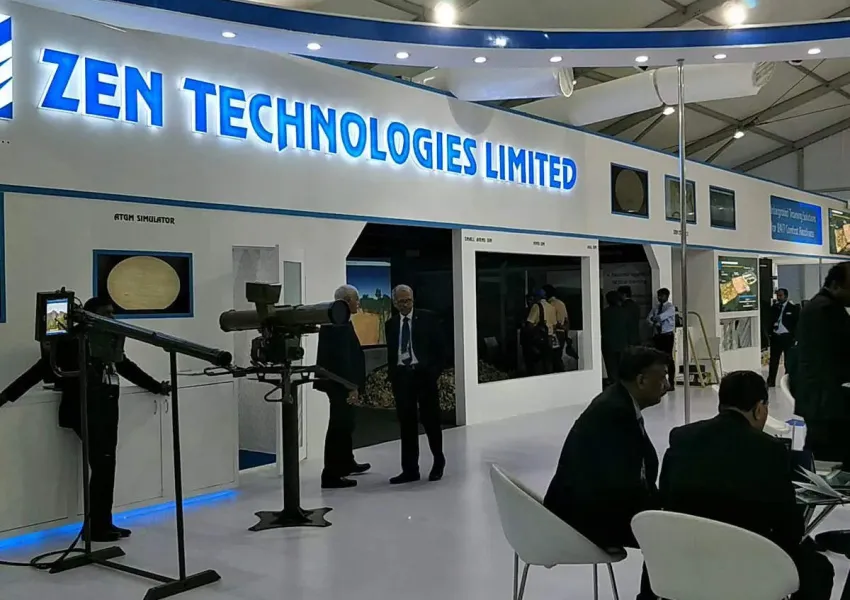
1. At a Glance
Zen Technologies Ltd — the Hyderabad-based war-gaming prodigy that once simulated soldier training, is now also zapping rogue drones out of the sky. The Q2FY26 numbers came in like a slightly misfired mortar shell: revenue slipped to ₹174 Cr (down 28% QoQ), while PAT clocked ₹58.7 Cr (down 6.3% QoQ). The market didn’t miss it — the stock has been hammered over 21% in the last 3 months, currently hovering around ₹1,396 with a market cap of ₹12,609 Cr.
Yet beneath the temporary smoke lies a war chest of ₹675 Cr in confirmed orders, a near-zero debt balance sheet (Debt: ₹18 Cr, D/E: 0.01), and ROE north of 26%. P/E at 51 looks steep, but that’s the price you pay when India’s defense establishment loves your products and foreign clients start calling you by first name.
ROCE of 37%, OPM of 38%, and an export order book touching 40% hint that Zen is slowly turning global. Just that — investors need to handle turbulence like a drone pilot mid-jamming zone.
2. Introduction
Imagine an Indian startup that didn’t sell chai, edtech, or co-living spaces — but simulated tank battles and developed anti-drone warfare systems when “drone” meant something you used for wedding videography. That’s Zen Technologies.
From the humble 1996 beginnings in Hyderabad’s defense R&D corridor, Zen went from “video game for jawans” to “jamming real enemy drones” faster than most PSUs could schedule their AGMs. The company now stands as India’s largest supplier of combat training simulators and anti-drone systems — and yes, they actually make things that go boom (virtually, of course).
But FY26 hasn’t been all glory. The order book, which was a beefy ₹1,434 Cr in Q3 FY24, is now trimmed down to ₹817 Cr. That’s not a typo — nearly 43% evaporated like an army mess biryani under free lunch policy.
Still, with 52% of the book from the anti-drone segment and exports rising to 40%, Zen’s transformation from training vendor to high-tech defense tech exporter is well underway. And in an era where every country wants its own defense ecosystem, Zen’s timing could be perfect. Or, like every defense project, delayed due to “pending permissions.”
3. Business Model – WTF Do They Even Do?
Zen Technologies is like the IIT topper who joined the army but decided to build the guns instead of firing them. The company builds training simulators, anti-drone systems, and combat training centers.
Let’s break it down:
- Live Ranges: Fancy shooting ranges with smart targets and moving dummies. Think of it as Call of Duty, but with bureaucratic approvals.
- Live Simulation: TacSim and ACTS — laser-tag for professionals. Soldiers train without casualties, commanders monitor in real-time, and procurement officers take selfies.
- Virtual Simulation: The company’s bread and butter — ATGM, Mortar, and Tank simulators. Basically, Zen turns every cadet into a VR gamer with a purpose.
- Combat Training Centres (CTC): Full-scale, 24/7 simulated battle environments. Imagine Disneyland, but with smoke grenades.
- Operational Equipment: The fun stuff — like ShootEdge, a device that lets you shoot around corners, and the Counter-Unmanned Aerial System (CUAS) — an anti-drone technology that detects, tracks, and neutralizes drones using radar, RF, and jammers.
The company’s customers include the Indian Army, Air Force, Navy, state police forces, and friendly foreign governments. Roughly 90% of its revenue is repeat orders — which means defense clients love it (and their budgets reset every year anyway).
And the cherry on top? Zen is building its own R&D and manufacturing center in Goa, because