1. At a Glance
If Amul is the polite topper in class, Heritage Foods is the smart kid who cracked the viva with sarcasm. At ₹480 a share and a market cap of ₹4,456 crore, this South Indian dairy veteran has aged like curd — a bit sour in the short term but profitable in the long pour. The company just dropped its Q2FY26 results with revenue of ₹1,113 crore, PAT ₹51 crore, and an OPM of 7%. That’s a 9% YoY rise in sales and a mild 10% dip in profit because milk prices, like your landlord, never stop hiking.
It’s delivering a ROE of 20.2% and ROCE of 25.3%, keeping the accountant community grinning wider than a cow after grazing season. Stock P/E at 26× is a cool discount to Hatsun’s absurd 66×, and debt-to-equity of 0.21 means it doesn’t owe much to anyone — except maybe a few cows. Over five years, profit growth averaged 25% CAGR, because apparently, this milkman knows compounding better than some mutual fund managers.
So what’s cooking? Legal wins, new ice cream factories, ghee price cuts, and a classic desi brand learning to flirt with e-commerce. Intrigued? You should be.
2. Introduction
Imagine if your morning milk packet had a LinkedIn profile — Heritage Foods would flex its ISO 22000, 9001, 45001, 14001, 50001, and HALAL badges like a B-school topper listing every extracurricular. Incorporated in 1992, this Hyderabad-based dairy child of N. Chandrababu Naidu’s family has quietly turned from a political side hustle into a ₹4,000+ crore FMCG player.
The stock has been on a lactose roller coaster — down 25% in the last year, but up 44% in three years. That’s the stock market equivalent of a buffalo run: slow, heavy, but with serious horsepower once it starts.
Meanwhile, in the kitchens of southern India, Heritage milk still fights the Amul invasion like Baahubali defending Mahishmati. It’s got 1.8 million litres of milk procured daily from 3 lakh farmers, 18 processing plants, and over 1.8 lakh retail outlets. If logistics is the war, they’ve already deployed 2,000 delivery vehicles.
But before you think this is all “Moo and chill,” the company also makes paneer, curd, ghee, buttermilk, laddus, yogurt, and ice cream, because milk alone doesn’t buy you market share. It buys you entry — and then, value-added products (VAPs) bring the cash.
Now, let’s milk this story fully.
3. Business Model – WTF Do They Even Do?
Heritage Foods’ business model is like a dairy buffet: a bit of everything to keep every P&L column full.
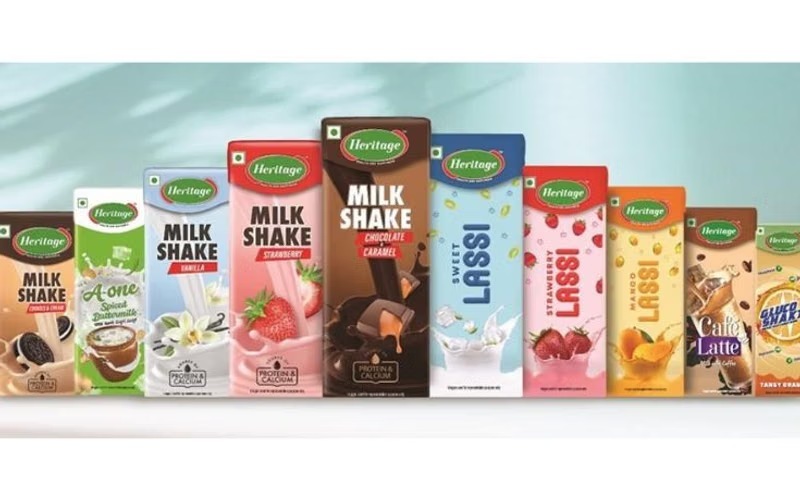
- Dairy Division (96% of revenue): This is the udder that feeds the company. Fresh milk, UHT milk, curd, paneer, cheese, lassi, flavored milk, ice cream — you name it, they’ve homogenized it.
- Animal Feed (4% of revenue): Through its subsidiary Heritage Nutrivet, it makes cattle feed because if you want high-margin milk, you must keep your cows eating premium stuff — basically “farm-to-P&L.”
- Renewable Energy: The company runs a few hydel projects (though one is currently non-operational). Probably to offset the guilt of running 2,000 diesel vehicles daily.
Procurement happens across 9 states, selling across 19. From Andhra Pradesh to Haryana,