1. At a Glance
If pipes could talk, Jindal Saw’s would probably say — “Bhai, hum flow kar rahe hain, par profit leak ho gaya hai!”
After posting a Q2 FY26 standalone PAT of ₹152 Cr (down 69% QoQ and 61% YoY), the ₹12,192 Cr market cap pipe powerhouse finds itself caught between shrinking profits and expanding geographies.
At ₹191/share (down nearly 48% YoY), the stock trades at 8.9× P/E, just above its book value (1.07×) — cheaper than your local plumber’s ego. Sales this quarter came in at ₹4,234 Cr, a 24% drop QoQ, showing how global project delays, arbitration drama, and CCI raids can puncture even industrial steel.
With ROCE of 19.4%, ROE of 16.3%, and a debt reduction from ₹3,819 Cr → ₹2,913 Cr in FY25, the company still flexes operational muscles. But between NTPC court battles, Saudi JV expenses, and pellet price fatigue, Jindal Saw’s Q2 looks like an episode of “Pipes of Thrones” — full of power, pressure, and leaks.
2. Introduction
In the universe of steel pipes, where one end connects to oil fields and the other to government tenders, Jindal Saw sits as the desi overachiever who has seen everything — from global expansions to courtroom battles. Founded by the Jindal Group, the company doesn’t just make pipes; it practically veins India’s industrial bloodstream — oil, gas, water, sewage, even oxygen pipelines — sab inka maal hai.
And yet, just when investors thought the steel pipe party was heating up post-FY24’s dream margins (17% OPM, 27.18 EPS), Q2 FY26 arrived with a reality check: OPM crashed to 11%, PAT dropped 69%, and the company’s Delhi office got surprise visitors — not customers, but Competition Commission of India (CCI) inspectors.
Coincidence? Maybe. Comic timing? Definitely.
Jindal Saw’s quarter reads like a Netflix series — one episode with an NTPC arbitration worth ₹1,891 Cr being overturned, another with UAE and Saudi JVs worth USD 118 Mn, and a subplot about debt shrinking faster than its profit.
So, dear reader, tighten your flanges — we’re diving deep into how this rust-free iron empire is dealing with rusted profits.
3. Business Model – WTF Do They Even Do?
Let’s decode Jindal Saw’s business without sounding like a metallurgy textbook.
They’re in the pipe mafia — legally, of course. They manufacture:
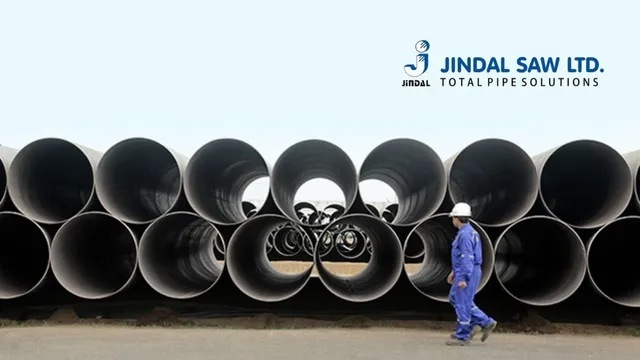
- LSAW pipes (Longitudinal Submerged Arc Welded): For oil, gas & water pipelines.
- HSAW pipes (Helical Submerged Arc Welded): For long-distance fluid transport.
- DI pipes (Ductile Iron): The kind your city’s water supply depends on.
- Seamless pipes: For heavy industry, thermal power plants & energy infrastructure.
- Pellets: Because why waste low-grade iron ore when you can turn it into profit pellets?
But that’s not all. They also own iron ore mines in Rajasthan — 1,989 hectares of low-grade iron ore with 180 Mn tons of reserves, a 50-year lease, and a zero-chill attitude toward imports.
The company’s global empire stretches across India, the UAE, and even the US.