(Because every Bollywood comeback needs an international collaboration.)
1. At a Glance
Yes Bank — the once-fallen angel of Indian banking — has done something wild again. In Q2 FY26, it clocked ₹7,389 crore in revenue and ₹654 crore in net profit, up 17% YoY, even as the stock floated at ₹22.2 like that relative who shows up at weddings just to prove they’re still around.
Market Cap? A chunky ₹69,800 crore. Book Value? ₹15.7.
P/E? A modestly cocky 24.6x, because redemption isn’t cheap.
NIM: 2.4% (still allergic to improvement).
GNPA: 1.6% (down from a horrifying 13.9% three years ago).
ROE: 5.46%, ROA: 0.59%.
And oh, in September 2025, Japan’s Sumitomo Mitsui Banking Corporation (SMBC) swooped in and picked up a 24.22% stake, making it the new boss in town — with SBI exiting like an ex who finally got closure.
Yes Bank’s story now has it all: A near-death experience, a government-led resurrection, and a foreign suitor. The Q2 results show a bank that’s stable, solvent, and slightly profitable.
2. Introduction
If Indian banking were a soap opera, Yes Bank would be the character that fakes its death in Season 3 and returns in Season 5 with a new haircut and a Japanese accent.
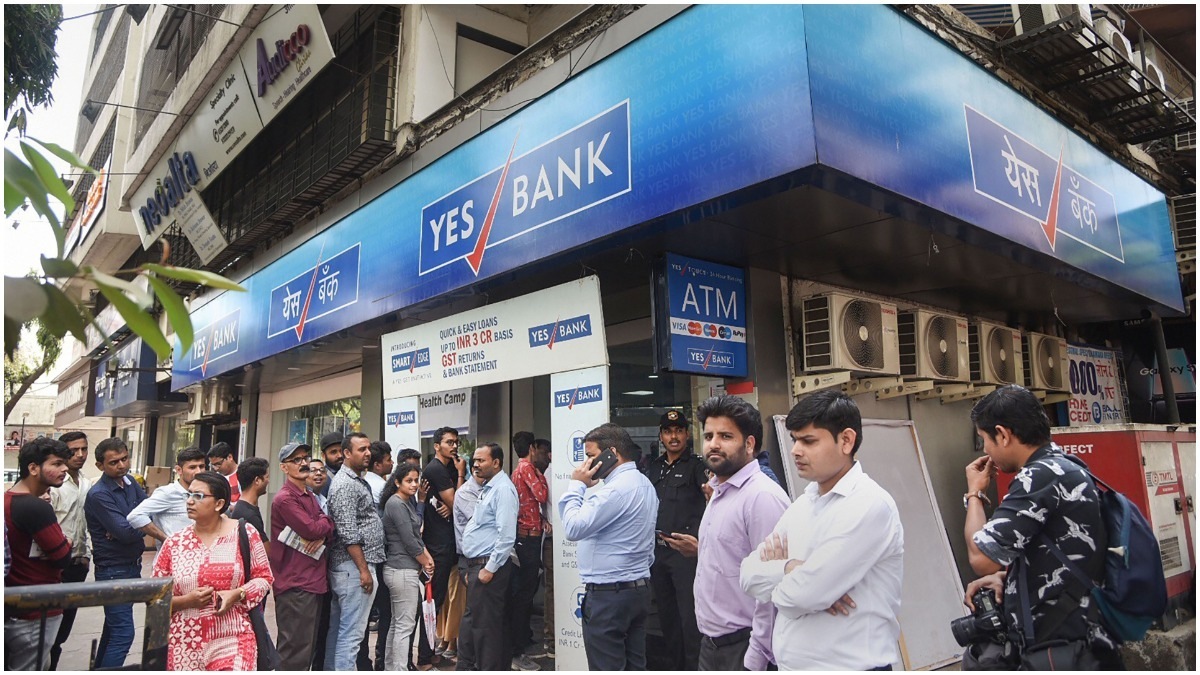
Back in 2020, it was a financial crime scene — deposits fleeing, ATMs gasping, and WhatsApp experts predicting Armageddon. The RBI slapped a moratorium, SBI and friends played paramedic, and the “Reconstruction Scheme 2020” became the bank’s life-support machine.
Fast forward to FY26 — Yes Bank is finally breathing on its own. Retail loans are up, corporate NPAs are down, and the treasury division is behaving like it’s attended anger-management therapy.
It’s also rebranded itself as a digital-first lender, launching “iris by Yes Bank” — a mobile banking app with 230+ features, 90% digital transactions, and a borderline obsession with UPI dominance (every third UPI transaction in India passes through them).
Yet, beneath the digital glitter, profitability remains fragile. The NIM — at 2.4% — still whispers, “We’re not HDFC yet.”
But you have to admit: coming back from ₹–16,000 crore losses in FY20 to ₹2,837 crore PAT in FY25 is no joke. That’s not a turnaround — that’s resurrection with Wi-Fi.
3. Business Model – WTF Do They Even Do?
Yes Bank does everything your neighborhood fintech dreams of — but legally.
Core Segments (Q2 FY25 mix):
- Retail/SME: 51% (up from 41% in FY22 — yes, the bank finally found normal customers).
- Corporate Banking: 29% (down from 43% — no more funding companies that vanish).
- Treasury & Head Office: 21% (up from 16% — where