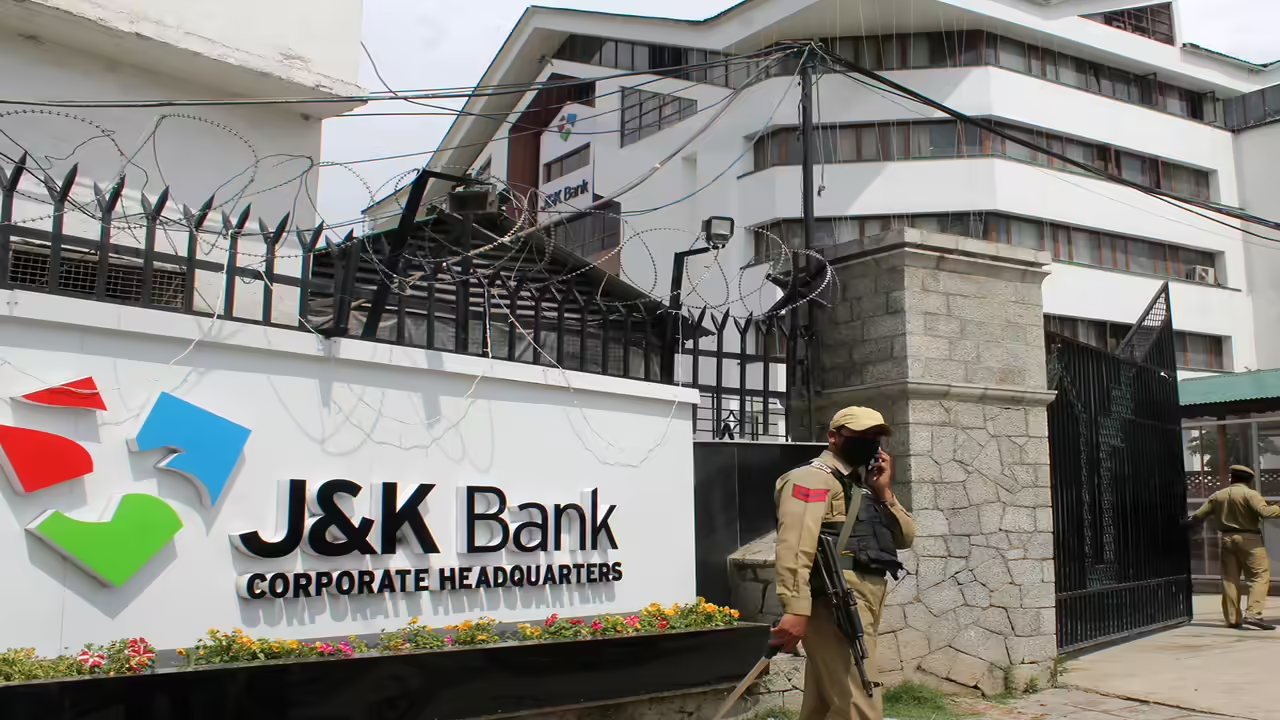
Jammu & Kashmir Bank Ltd – From NPA Horror Show to ₹2,148 Cr Profit, and Still Fighting GST Demons 💸🏦
1. At a Glance
Once infamous for NPAs fatter than Kashmir’s wazwan thali, Jammu & Kashmir Bank (JKB) has staged a comeback with GNPA down to 3.95% and profits hitting ₹2,148 Cr in FY25. With 86% of its branches huddled in J&K and Ladakh, this is less of a “pan-India private bank” and more of a regional sultan. But don’t get fooled — with a P/E of just 5x, book value higher than CMP, and a dividend yield of 2.1%, this bank is a PSU in private clothes.
2. Introduction
JKB is that kid in class who topped in maths (NIM 4%) but always got caught in disciplinary cases (RBI fines, SEBI warnings, GST disputes). The bank was once a political football, drowning in bad loans. But recent clean-up has made it semi-presentable: NPAs halved, CASA ratio close to 50%, and profitability zooming.
Business-wise, it’s a cocktail: 60% retail, 21% treasury, 19% corporate. Translation: lending to local shopkeepers, parking surplus in bonds, and giving a few big cheques to corporates (and praying they pay back).
But the real masala is geography: 72% of loans and 89% of deposits sit in J&K & Ladakh. Which means:
If tourism booms, JKB parties.
If curfews or floods hit, JKB cries.
Now they’re pushing digital banking with mPay Delight+ (basically UPI with Kashmiri kahwa branding). 86% of transactions are already digital — impressive for a region where even power cuts are routine.
Question: Is JKB really transforming, or just hiding old skeletons behind new fintech curtains?
3. Business Model – WTF Do They Even Do?
JKB’s business is basically three pillars:
Retail (60%) – Personal loans, housing, small businesses. This keeps the cash register ringing.
Corporate (19%) – Riskier, but gives size. Think of it as lending ₹500 Cr to one borrower instead of 5 lakh customers. Historically this is where NPAs mushroomed.
Treasury (21%) – Investing in bonds, playing with yields. Their safe zone, but sensitive to interest rate swings.
Deposit side: ₹1.38 lakh Cr, split evenly — Term Deposits (51%) vs CASA (49%). That’s decent, but not HDFC-class.
Loan book: ~₹1 lakh Cr, with 39% in personal finance (salary earners, safe), 21% in trade & services, and 10% each in agriculture and financial markets. Manufacturing is just 7% — not a bank for Tata Steel types.
They also sponsor J&K Grameen Bank (216 branches, 1,226 staff). Basically, a rural cousin that collects goat-farmer deposits while JKB handles city buzz.
4. Financials Overview
Source table
Metric
Latest Qtr (Jun’25)
YoY Qtr (Jun’24)
Prev Qtr (Mar’25)
YoY %
QoQ %
Revenue
₹3,269 Cr
₹2,994 Cr
₹3,213 Cr
+9.2%
+1.7%
Operating Profit
₹406 Cr
₹415 Cr
₹404 Cr
-2.2%
+0.5%
PAT
₹485 Cr
₹418 Cr
₹582 Cr
+16.0%
-16.7%
EPS (₹)
4.40
3.80
5.28
+15.8%
-16.7%
Commentary: Strong YoY growth, but sequential dip. EPS swings like the Dal Lake shikara in a storm.
5. Valuation – Fair Value Range Only
P/E Method: EPS TTM = ₹19.5. With private banks at 10–15x, fair range = ₹195 – ₹290.
P/B Method: Book Value = ₹129. At 0.8x CMP, fair range assuming 1–1.5x = ₹130 – ₹195.