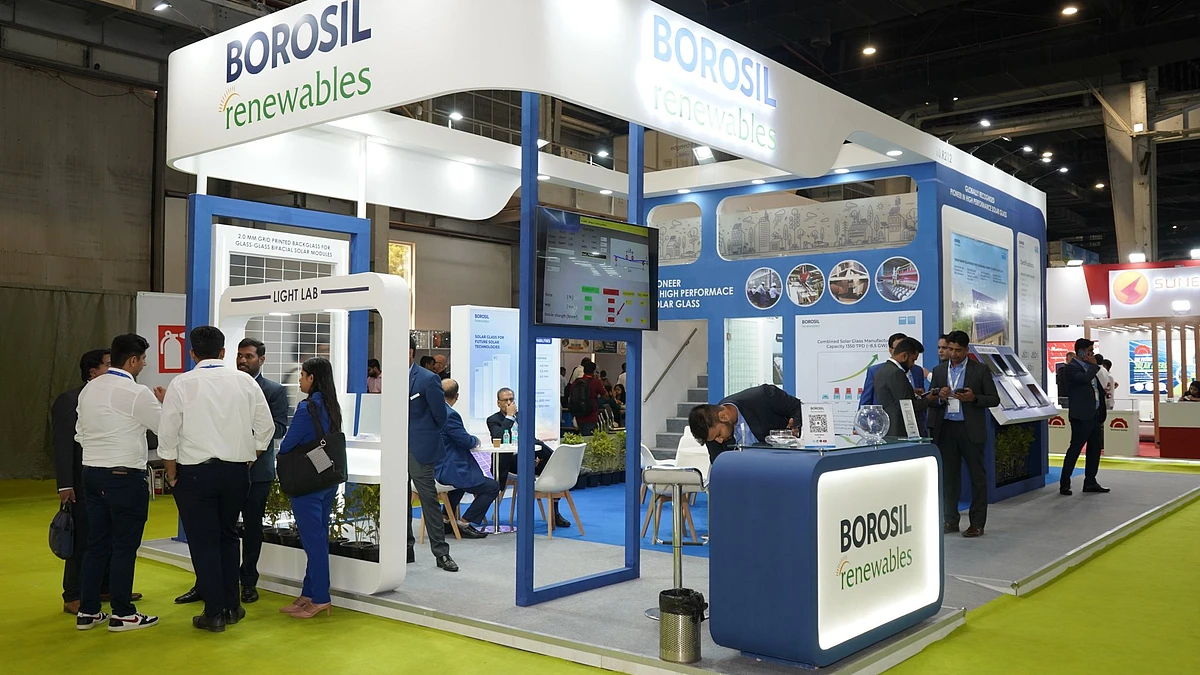
Borosil Renewables Ltd – From Shining Solar Glass to German Glass Crash
1. At a Glance
Borosil Renewables, India’s only listed solar glass maker, went global, bought a German business, and then watched it file for insolvency faster than a builder promises “possession in 18 months.” Once a high-margin darling with 38% OPM, today it’s struggling at 4% margins, posting losses, and praying that anti-dumping duties keep Chinese imports out of India. It’s a desi solar glass story with filmi drama: Europe ki barbaadi, India ki aasha.
2. Introduction
This is the same Borosil you know from your school lab beakers and that unbreakable tea cup in your dadi’s kitchen. But here, we’re talking about Borosil Renewables — the solar glass arm.
The company makes “low iron solar glass,” basically the transparent stuff that lets your rooftop solar panel charge your Wi-Fi router while you binge Netflix. In India, it owns more than 20% market share and dominates as the only domestic manufacturer. Abroad, through its now-bankrupt German subsidiary GMB, it briefly controlled 65% of Germany’s solar glass market — before Germany itself pulled a U-turn on its energy subsidies and Chinese imports wrecked pricing.
What’s fascinating? Between FY22 and FY24, revenues doubled, but profits turned into losses. It’s like opening more shops but selling at “Buy 1, Get 3 Free” margins. Today, Borosil Renewables stands at ₹7,683 Cr market cap, trades at 7.6x book value, and has investors scratching their heads: “Is this a green energy turnaround story, or just another ‘import se barbaad’ tale?”
3. Business Model – WTF Do They Even Do?
Think of Borosil Renewables as the glass supplier to every solar dream project. Their products:
Low iron solar glass (extra clear, matt-matt finish, anti-glare, anti-reflective).
2mm tempered glass for panels.
Grid-printed glass and textured variants from R&D labs.
They sell:
Domestic (59% of sales FY24): Panels for Indian rooftop and utility-scale projects.
Exports (41% of sales FY24): Europe, USA, Canada, Egypt, Mexico, Brazil — basically wherever the sun shines and subsidies exist.
Capacity:
Bharuch, Gujarat = 1,000 TPD across 3 furnaces.
Germany = 350 TPD (through GMB, now under insolvency).
They had expansion plans (1,100 TPD furnace SG-4), but dumped them due to Chinese price pressure. Now they’re pivoting to India-first with ₹950 Cr capex.
So, WTF do they do? They’re the glass window between the sun and your electricity bill. But right now, Chinese imports have smashed that window with a hammer.
4. Financials Overview
Source table
Metric
Latest Qtr (Jun’25)
YoY Qtr (Jun’24)
Prev Qtr (Mar’25)
YoY %
QoQ %
Revenue (₹ Cr)
374
283
361
+32%
+4%
EBITDA (₹ Cr)
15
22
-10
-32%
NM
PAT (₹ Cr)
-20
-53
-30
+62%
+33%
EPS (₹)
-1.5
-3.7
-2.0
+60%
+25%
Commentary: Revenue up, losses down, but still bleeding. EPS is still negative — basically a cricket match where the team is chasing but losing wickets every over.
5. Valuation – Fair Value Range
P/E: EPS TTM = -₹5.3. P/E = Not meaningful.
EV/EBITDA: EV = ₹7,866 Cr, EBITDA TTM ~₹76 Cr → 104x. Fair range for industrials = 12–18x → fair EV ~₹900–₹1,400 Cr → per share ₹65–₹100.
DCF: Assume EBITDA margins rebound to 20% by FY27, revenues grow 15% CAGR → fair range = ₹150–₹250/share.
🎯 Fair Value Range = ₹65–₹250/share. Disclaimer: This fair value range is for educational purposes only and is not investment advice.